Active ingredients provide a medicine’s intended treatment effect. Inactive ingredients help make, preserve, or deliver it. To identify them, check the ingredient sections on the exact product you have. The brand name alone is not enough.
Two boxes with similar names can contain different medicines. The same medicine from different manufacturers may also contain different inactive ingredients. Here is what to check before using a product or asking about a reaction.
1. Find the ingredient lists
For US over-the-counter medicines: look for the Drug Facts panel. The active ingredient section gives the ingredient name and amount per dosage unit. Inactive ingredients have their own section. Read the warnings and directions too; an ingredient list does not tell you whether a product is suitable for you.
For prescription medicines: the pharmacy bottle may not list every inactive ingredient. Ask your pharmacist for the manufacturer’s full labeling or package insert for the product dispensed. Do not assume a label found for another manufacturer is an exact match.
The FDA’s Drug Facts guide explains the OTC sections. For other package details, see our guide to reading a medicine package.
2. Separate strength from dose
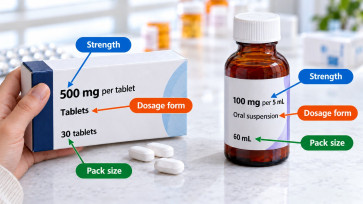
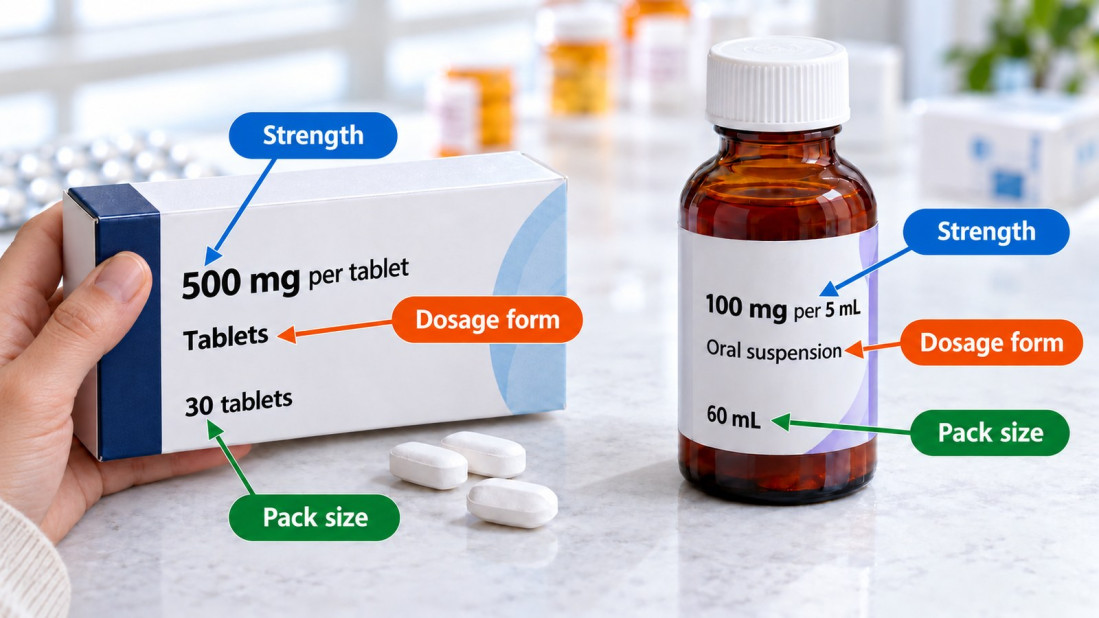
Strength tells you how much active ingredient a product contains per tablet, capsule, or stated liquid volume. Dose is the amount taken at one time. The dosing schedule also specifies when or how often it is taken.
For example, “500 mg per tablet” describes strength. It does not, by itself, tell you how many tablets to take. For a liquid, read the complete concentration, including both mg and mL. Follow the product directions or your prescriber’s instructions rather than calculating a new dose from the strength.
3. Understand what inactive ingredients do
A tablet needs more than its active ingredient. Other ingredients can hold it together, help it break apart, preserve a liquid, improve taste, or control how the medicine is released. Examples include cellulose, starch, flavorings, and certain coatings.
“Inactive” describes an ingredient’s role in that formulation. It does not mean it has no effect on anyone. If a coating controls release, changing or crushing the tablet may affect how it works. Ask a pharmacist before crushing, splitting, or opening a medicine.
4. Distinguish an allergy from an intolerance
An allergy involves the immune system. An intolerance can cause symptoms without an allergic immune response. Both deserve attention, but they are not interchangeable terms.
Lactose intolerance is difficulty digesting lactose, a sugar. It differs from milk allergy, which is a reaction to milk proteins. Finding lactose in a medicine does not establish whether that particular product is suitable for someone with either condition. Ask your pharmacist to check the exact formulation and, when needed, confirm details with the manufacturer.
NIDDK explains the difference between lactose intolerance and milk allergy. Tell your pharmacist the ingredient involved and what happened previously, rather than describing every reaction as an allergy.
5. Compare the exact products
Check the active ingredient, strength, dosage form, release type, and manufacturer. Then compare inactive ingredients if you have a known sensitivity. FDA-approved generics must meet equivalence requirements, although certain inactive ingredients can differ from the brand product.
A different color or shape alone does not show that a generic is less effective. See the FDA’s generic medicine questions and answers. Avoid combining medicines just because their brand names differ; ask whether their active ingredients overlap.
What to ask your pharmacist
- Where is the complete ingredient list for this manufacturer’s product?
- Does it contain the ingredient linked to my previous reaction?
- If an alternative is needed, does it match the prescribed medicine and release type?
Bring the packaging and describe your symptoms. Our questions to ask before starting a new medicine can help you prepare.
Frequently asked questions
Are inactive ingredients always the same across brands?
No. Check the exact manufacturer and formulation, including when the supplier changes.
Does a pharmacy bottle show the full ingredient list?
Not necessarily. Your pharmacist can help locate the full labeling for the product you received.
Can I decide my dose from the active ingredient amount?
No. Strength is only one part of the information. Use the directions or prescribed instructions, and ask if they are unclear.
This guide explains label terms and does not replace advice about your specific medicine, allergy, or treatment.
Written by GetCareVia Team. Updated October 21, 2026.