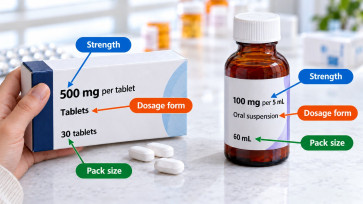
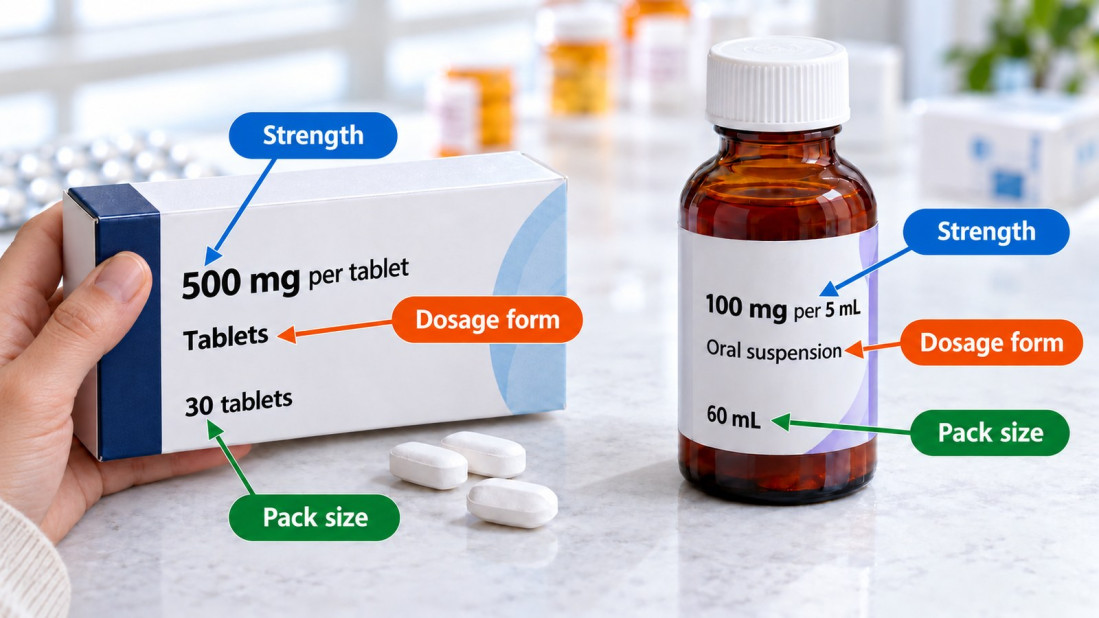
A medicine package can show several numbers at once: a strength in milligrams, a liquid concentration, and the number of tablets or the volume in the container. Each answers a different question. Strength describes the amount of active ingredient in a stated unit. Dosage form describes the type of medicine, such as a tablet, capsule, cream, or solution. Pack size describes the quantity supplied.
This guide explains how to read those details. It does not tell you which medicine or dose to use.
Start with the exact medicine name
Read the active ingredient name as well as the brand name. Similar brand names can appear on products with different ingredients. A familiar name alone is not enough to identify a medicine.
Keep the ingredient name, strength, dosage form, and pack size together when checking a package against a GetCareVia product listing. If any detail is unclear, ask for a readable label rather than filling in the missing information yourself.
What does medicine strength mean?
Strength states how much active ingredient is present in the unit identified on the label. Read the number and its unit together. Milligrams (mg) describe mass; milliliters (mL) describe volume. They are not interchangeable units.
- 500 mg per tablet: each tablet contains the stated 500 mg of active ingredient.
- 100 mg per 5 mL: the stated amount applies to 5 mL of liquid, not to the whole bottle.
- Two listed ingredients: check the strength beside each ingredient rather than assuming one number describes both.
These are fictional reading examples, not product recommendations. The wording on the actual label matters. If a liquid package shows both a concentration and a bottle volume, record each separately.
For background on the ways strength and concentration are expressed, see FDA’s strength and concentration guidance.
Strength is different from dosage
The strength number does not tell you how many tablets to take or how often to take them. Those instructions belong in the directions or your prescription instructions. Do not calculate your own treatment schedule from the package strength.
What is a dosage form?
Dosage form identifies the physical preparation. FDA’s dosage-form list includes tablets, capsules, creams, solutions, suspensions, and other forms. It also distinguishes forms such as chewable tablets, orally disintegrating tablets, and extended-release tablets.
Copy the full form description when comparing packages. “Tablet” and “extended-release tablet” are different label descriptions even when the ingredient name and strength look similar. A matching strength alone does not establish that two products can be substituted.
If you need help deciding whether a form is suitable or whether a tablet can be altered, ask a pharmacist about the exact product.
What does pack size tell you?
Pack size is the quantity in the package. It may be a tablet count, capsule count, liquid volume, or the weight of a cream. It is separate from the ingredient strength.
| Example package wording | Strength or concentration | Pack size |
|---|---|---|
| 500 mg per tablet; 30 tablets | 500 mg per tablet | 30 tablets |
| 100 mg per 5 mL; 60 mL bottle | 100 mg per 5 mL | 60 mL |
These examples are fictional. A larger pack does not mean a stronger medicine. Likewise, a 30-tablet pack is not automatically a 30-day supply; that would depend on the prescribed or labeled directions.
Reading strip and box quantities
If a box states “3 strips of 10 tablets,” the total is 30 tablets. Check whether an online quantity refers to individual tablets, strips, or boxes. “Three packs” is incomplete unless the quantity in each pack is also clear.
Read beyond the front of the package
For U.S. OTC medicines, the Drug Facts panel described by FDA includes ingredient information, uses, warnings, and directions. Read that panel rather than relying on a product title or front-panel number. Prescription medicines may include pharmacy instructions and additional patient information; read the materials supplied with the exact product.
Packaging from another country may use a different layout. This guide does not establish a product's U.S. approval, prescription status, or import eligibility.
For help understanding storage instructions, see our guide to storing medicines safely at home.
A practical way to compare two package descriptions
Write down four fields for each package: active ingredient, strength, full dosage form, and total quantity. Compare one field at a time. This makes it easier to notice a difference that a short product title might hide.
For example, imagine two fictional listings both say “500 mg tablets.” One supplies 30 tablets, while the other supplies three boxes. You can compare their strength descriptions, but you cannot compare their total quantities until you know how many tablets each box contains. Ask for that detail instead of assuming the boxes have the same contents.
Keep the label photograph with your notes. If the photo and written description disagree, do not use one to silently correct the other. Ask the retailer to clarify the exact package being supplied. A complete description helps identify an item; it does not prove therapeutic equivalence or determine whether you should use it.
Questions to resolve before relying on a listing
- Is the active ingredient name readable?
- Does the strength specify its unit or concentration?
- Is the full dosage form shown?
- Does the quantity refer to tablets, strips, boxes, weight, or volume?
- Does the listing match the package photograph?
For a question about a GetCareVia listing or package quantity, contact GetCareVia support. Questions about treatment, dosing, or substitution should go to a licensed pharmacist or your clinician. For order logistics, review the Shipping Policy; shipping information does not establish that a particular medicine is eligible for U.S. sale or import.
Sources
Sources checked October 9, 2026. This article provides general label-reading information and does not replace professional medical advice.